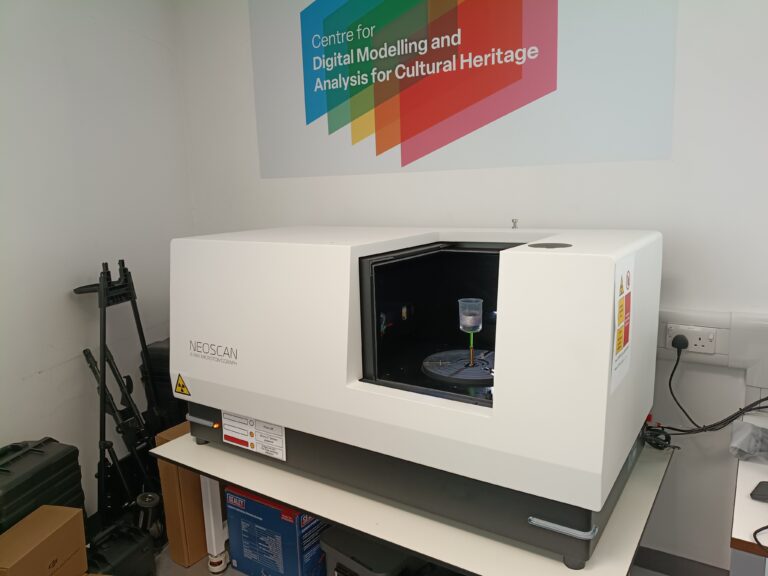

D-MACH’s work-horse surface scanner – the Creaform Black Elite
Our next piece of kit we're showcasing is the Creaform surface scanner
It’s funny to call something so high-tech the “work-horse” of the D-MACH lab, but based on use and versatility, the Creaform Black Elite, bought using the AHRC RICHeS grant, seems to be a popular go-to for surface scanning.

What does it do?
Surface laser scanners like the Creaform capture the 3D exterior geometry of objects. Typical object sizes are a few centimetres to a few metres. The data is highly precise and can be used to create detailed digital meshes. It doesn’t capture surface colour, but what you lack in colouration, you gain in accuracy, with measurement confidence at a fraction of a millimetre. As with nearly all the techniques at D-MACH, surface laser scanning is non-destructive and can capture information from most types of surfaces.
When laser scanning is used in conjunction with a technique like photogrammetry, it’s possible to overlay the two datasets to give the best of both worlds. Real colour and texture and high precision measurements.
The Creaform is portable, so ideal for us to take off-site from the lab and visit museums and collections around the North West and beyond. (So far it’s been on outings to Thackray Museum of Medicine and Rufford Old Hall (National Trust) to name but two!)
How does it work?
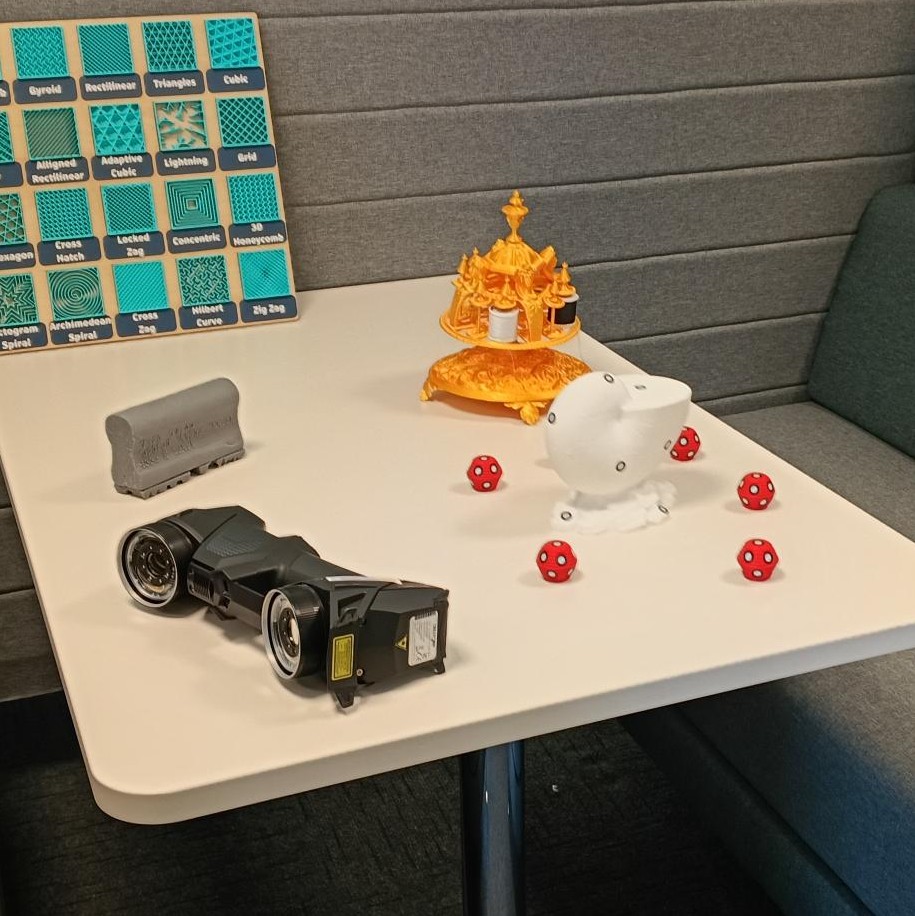
The Creaform builds up a 3D model in real-time as the object is being scanned. It does this using two processes. Small calibration stickers are placed around (or if appropriate on) the object being scanned. This allows the scanner to locate itself in space. The second process is by projecting a grid of blue laser light onto the object. The cameras in the scanner record the reflections of the blue light as it is deformed by the surface of the object.
What are the limitations?
Objects need to be stable for the length of scanning to allow all the sections of the data to align together. That said, even a pot plant could, theoretically, be scanned if there’s no wind!
Black and mirror-reflective surfaces can cause artifacts in the data and thin structures like chair legs can be difficult to capture. But, it’s surprising what the system can handle, even outside of the expected working parameters. Just ask one member of D-MACH who successfully scanned an entire rood screen in a church!
Creaform: part of the D-MACH workflow
The Creaform can become part of a multi-scale surface scanning workflow where a large space is imaged using our room-scale lidar scanners and key items of interest are scanned at higher resolution using the Creaform.
Acquisition of surface data is only the first step in learning more about an object. When the data is loaded onto a computer it can be fully manipulated and relit, potentially revealing features not seen to the naked eye. This is particularly useful for faint engravings like worn lettering on stone work. And, of course, we can bring the digital back into the physical by 3D printing objects which can be used for tactile displays and museum handling collections.
If you have a project in mind which might be suitable for the Creaform, or any of the equipment at D-MACH, complete the form here.
To speak to a member of the team with general questions visit here.